
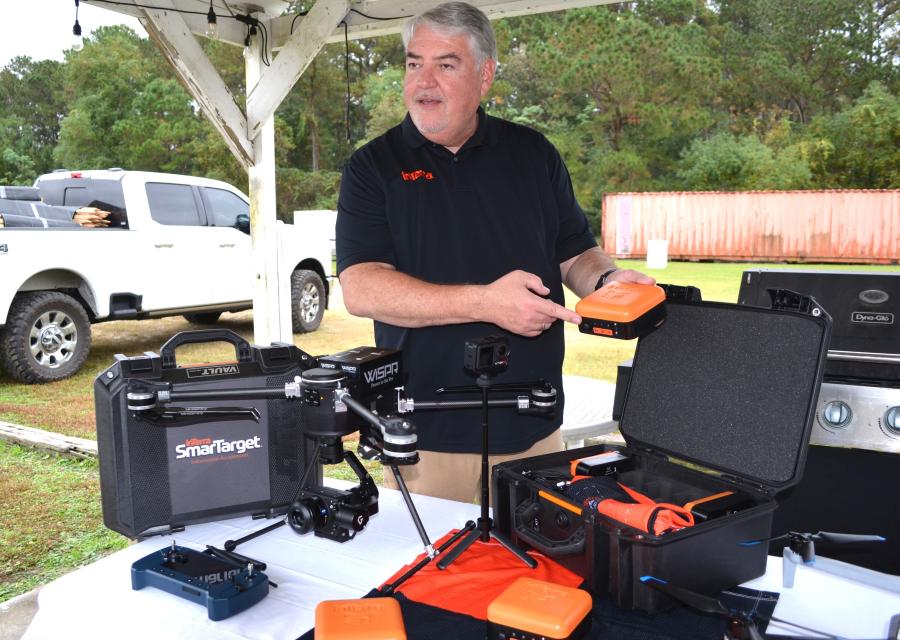
HUNTSVILLE, Ala. — At InTerra, a small technology company in Alabama, AI is changing how engineers spend their days. Work that once required hours of routine programming can now be handled with the help of AI, leaving more time to design new software, test ideas and solve problems.
Turning Drone Photographs into Precise 3D Models
InTerra develops technology that allows engineers and surveyors to create detailed three-dimensional models of the physical world using drones, GPS receivers and photogrammetry software.
The applications are practical. A construction company can survey an entire job site in a day. A mining operation can calculate the volume of a stockpile. Engineers can track changes in terrain over time, comparing images taken weeks apart to see how a project is progressing.
InTerra’s SmarTarget ground control points help make those measurements more accurate. Using GPS technology, the devices automatically record precise locations, reducing the amount of manual surveying required in the field.
Behind each model is a substantial computing task. Hundreds or even thousands of drone photographs must be processed and assembled into a single digital reconstruction.
“We’ll spin up a machine that could run 44 to 88 cores,” said Peter Funk, InTerra’s chief technology officer, describing the computers, equipped with hundreds of gigabytes of memory, that the company uses to process imagery.
Less Coding, More Designing
But some of the company’s most consequential changes are taking place not in the field or on its powerful computers, but at the desks of its engineers.
Funk has begun using AI coding assistants, including Claude and GitHub Copilot, throughout his workday. Rather than writing every line of software himself, he can outline what a program needs to accomplish, review the code AI produces and refine the results.
“I’m really doing less coding and more designing and checking,” he said.
The tools have taken on a range of tasks: preparing technical documentation, updating user interfaces, organizing software repositories, creating tutorials and reviewing older code.
They can also spot mistakes.
While converting a program from one programming language to another, Funk recalled, an AI assistant identified six problems in the original code. Four were relatively minor. Two, it warned, could cause more serious trouble.
“AI looked at it,” Funk said, “and said, ‘I see what you’re doing … there are four things that were not quite right before, and two things that could really cause problems. Would you like me to fix those?”
For Funk, the appeal is not simply that AI can produce code quickly. It can also examine existing work, flag potential problems and suggest changes before an engineer commits to them. The engineer still has to decide what works.
Made in Alabama, Sourced Around the World
InTerra’s operations extend well beyond Huntsville.
Its custom circuit boards and antennas are manufactured in Texas. GPS receivers come from Switzerland. Other components arrive from Taiwan and Eastern Europe before the products are assembled.
For a small company building specialized technology, those international relationships are essential. Access to suppliers with the right technical capabilities can determine what a business is able to manufacture.
Funk said InTerra has paid close attention to where its components originate, a decision that has helped the company navigate disruptions to global supply chains.
“We’ve been very conscious,” he said, “where the manufacturing of all these parts were. It has paid off.”
The company’s experience illustrates how even a small American technology business can depend on a network of manufacturers and suppliers spread across several continents.
The Projects That No Longer Have to Wait
For Funk, one of AI’s most useful contributions is making previously impractical projects worth pursuing.
Software improvements that once seemed too tedious or time-consuming can now be tackled. Engineers can develop early prototypes, test whether an idea works and make changes without spending days writing routine code.
That changes how a small team allocates its time. Rather than devoting much of the day to the mechanics of programming, engineers can concentrate on the decisions that require their judgment: what to build, how it should work and whether the result is good enough.
At InTerra, AI has not eliminated the need for engineers. It has changed which parts of their jobs take the most time.
And for a small company with more ideas than hours in the day, that distinction matters.